

Beginning around age eleven I unleashed a collection of prose that persisted with little pause across the entire 1980s and forged my unalterable identity as a writer.
I started with drawing comic books inspired by Marvel brands such as The Incredible Hulk, and then produced little “novels” that grew longer and more complex with time. I wrote each of them on typewriters that progressed from manual to electric with corrective tape and white-out (I can still smell it after all of these decades) serving as important daily supplies, typing lightning fast with just one finger from each hand. I finished 15 novels before my senior year of high school, plus a dozen or so sketched-out ideas and outlines that never grew to bear the scented scars of that aforementioned white-out.
I supplemented this prose with song lyrics (sans musical knowledge or talent) that became particularly intense during high school, often writing the initial drafts while sitting in class with half my attention in the lecture and the rest in my head. Mrs. Themes might be teaching us Spanish verb tenses, Mrs. Coslow twittering on about moles-to-grams, or Mr. Carlson unpacking the 19th Century thought leadership of Marx and Engels; it didn’t matter. The initial lyrics would knock on my cognitive doors, demanding entry, and I would grab a clean sheet of notebook paper and scribble them down as fast as possible with my teachers and classmates unawares.
These coming of age literary offerings were unintentional journals. I’ve kept them in a plastic bin as I’ve moved geographically and psychologically. They are among the last physical remnants of my childhood, faded and fragile witnesses to parts of me I cannot discard, portents of what I would think, talk, and write about as an adult.
I kept them but didn’t reread them until I was 37, after my father died. I chuckled at my artwork, awkward dialogue, and simplistic plots, looking afresh for the four-eyed, stuttering boy behind the words.
The writings express a yearning for justice and truth to prevail, full of idealistic hope and hindered by inconsistencies and naiveté. I see a young person observing and pontificating, steeped in isolation even while surrounded by family, teachers, and peers, on a quest for
identity and belonging, wanting to become a famous writer with little interest in any other vocation.
One teacher who claimed I could become a successful novelist was Denny Bowden, my 10th grade English instructor who read some of my work. In the fall of 1983 or spring of 1984, Mr. Bowden recorded and gave me a cassette tape of his observations and advice, the most memorable being an urgency for me to write as much as possible and continue to improve, noting “you’ll be surprised how fast the years go by.”
How fast the years go by. I’d like to find Mr. Bowden and tell him just how prophetic he was, how I wanted to heed his warning but let life get in my way.
During my 20s, I worked as a journalist and lived in a non-fiction world of facts, details, deadlines, and editors. I attended more boring town council meetings than I could possibly remember. There was nothing left in my tank for creative writing. And I began to sense, for the first time, a fear of not realizing my creative potential, of failing to fulfill my deeper identity as a writer being affirmed by community as a poignant voice in the wind.
That fear became a stone in my shoe, a quiet but unsettling whisper that has nagged and kept me restless and dissatisfied, wondering what else is out there. At times it has paralyzed my creativity and motivation, caused stress in relationships, and in general led to a sense of resignation and an almost intentional embrace of Thoreau’s observation that most men “lead lives of quiet desperation.”
Attending graduate school at age 29 reignited a new season of introspective prose and, for the first time, public speaking. Although I’m no longer involved in organized religion, in that season I felt led to go to Asbury Theological Seminary where I earned a Master of Divinity followed by a few years of pastoring in the United Methodist Church. I wrote and delivered dozens of sermons, digging deep into the Old and New Testaments and created small group study materials, trying to find larger or more transcendent meaning in the sacred texts but never feeling I had found my “forever” career and eventually outgrowing monotheism altogether.
Thankfully, journalism, seminary, and pastoring paved the way for the work I’ve done since 2005 as an executive coach, leadership development facilitator, and program manager. I write every day in some form or fashion in the context of my work, for which I’m grateful, and spend my early mornings writing creative material.
During my 40s I wrote and self-published three books that are still on Amazon. Here in my 50s, I’ve developed novel outlines and multi-dimensional characters while actually “finishing” dozens of non-fiction prose pieces like the kind I share on Substack, LinkedIn, and Facebook. I remain convinced that there are still works of fiction inside of me, but for now my observations and reflections on the human condition call for non-fiction narratives…and I’ve stopped fighting that.
Writing.
The agony and the ecstasy.
The moments of tremendous flow amid the rush of ideas, and the seasons of getting stuck in my head and putting little onto the blank Word doc or Google doc.
It’s blatantly obvious that the clearest way out of a sense of not fulfilling one’s potential as a writer is to simply write. Emotions, distractions and even the hackneyed “writer’s block,” however, have their say and get in the way of the words, suppressing the drive and the perceived relevance of creative expression.
In his wonderful little book The Mindful Writer, Dinty W. Moore (not the sausage brand!) describes “The Four Noble Truths for Writers”:
1. The writing life is difficult, full of disappointment and dissatisfaction.
2. Much of this dissatisfaction comes from the ego, from our insistence on controlling both the process of writing and how the world reacts to what we have written.
3. There is a way to lessen the disappointment and dissatisfaction and to live a more fruitful writing life.
4. The way to accomplish this is to make both the practice of writing and the work itself less about ourselves. To thrive, we must be mindful of our motives and our attachment to desired outcomes.
In another quick read that I will keep forever, The War of Art, Steven Pressfield shares:
In the fortunate, talented few, the dark dimension of their natures will first resist the labor that creativity demands, but once they commit to the task, their talented side stirs to action and rewards them with astonishing feats. When inspiration touches talent, she gives birth to truth and beauty.
To be a writer intrinsically means to be somewhat of a scrambled mess. The light, the darkness, the constant interplay of emotions and passions that create the ebbs and flows, the highs and lows, also are what produce the scattered moments of brilliance that make the words meaningful, true, and life-changing.
I possess an incomparable sense of having accomplished something when I finish writing a piece that I can tell is good. I feel like I’ve dug deeper and found something worthy. I feel purposeful, life teems with meaning, and there’s a ceasefire with the urgent voice inside my head that’s hounded me with its demands that I write and write well and make a living as a writer and only write and change the world and be remembered as a writer…and stay enslaved to generating my own suffering, despite knowing those classic Four Noble Truths from Buddhism and Moore’s repurposing of them for the writing life.
I have no idea how many more years I have in front of me in this world, but I’m certainly well into my third quarter. And if I could begin to spend as much time writing as I do thinking or reading about writing, that next work of fiction might get its moment in the sun.
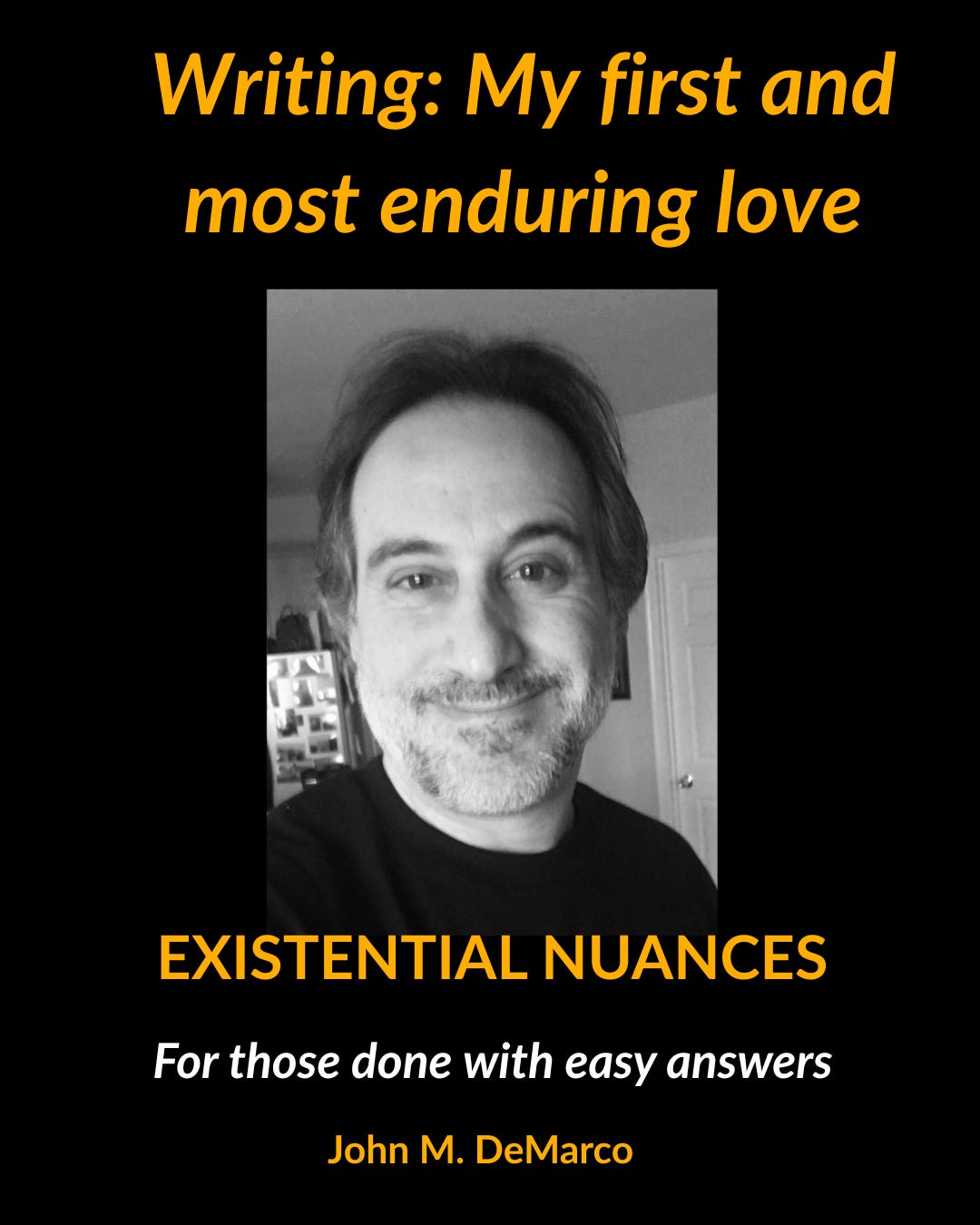
I nurture these Existential Nuances pieces within a manuscript that’s serving as an iterative first draft of a potential non-fiction book. I’ve been writing them since last fall and allowing the themes to organically emerge. Whatever happens, this Word document is growing into the foundational artifact of my life, a deep well of truth, a practice field for grappling with the human condition, hoping to help people “done with easy answers” by sharing stories and reflections on growth, loss, identity, and mindfulness.
Writing was and remains my first and most enduring love, coexisting with the deep love I have for my wife, children, siblings, other family members, and treasured friends. And just like anyone whom everyone has ever and will ever dare to love, writing sometimes breaks my heart and, more often, catalyzes all the “feels.”
I know less every day.
What I continue to understand, however, is that as a boy I became captivated by stories and have never stopped wanting to consume and create my own. I’ve stared down and dived headlong into the powerful tide that insists young people must grow up and leave their stories behind to find more pragmatic things to do.
Fifteen novels before senior year. Most people spend their whole careers waiting to feel ready enough to write one. You just… kept going. This piece is beautiful. 🌱🌿🌾
I really love your writing 🙏. It inspires me to be a better writer. I'm getting closer to 24:00 than 12:00 😆
What a fascinating journey you've had, creative and otherwise.